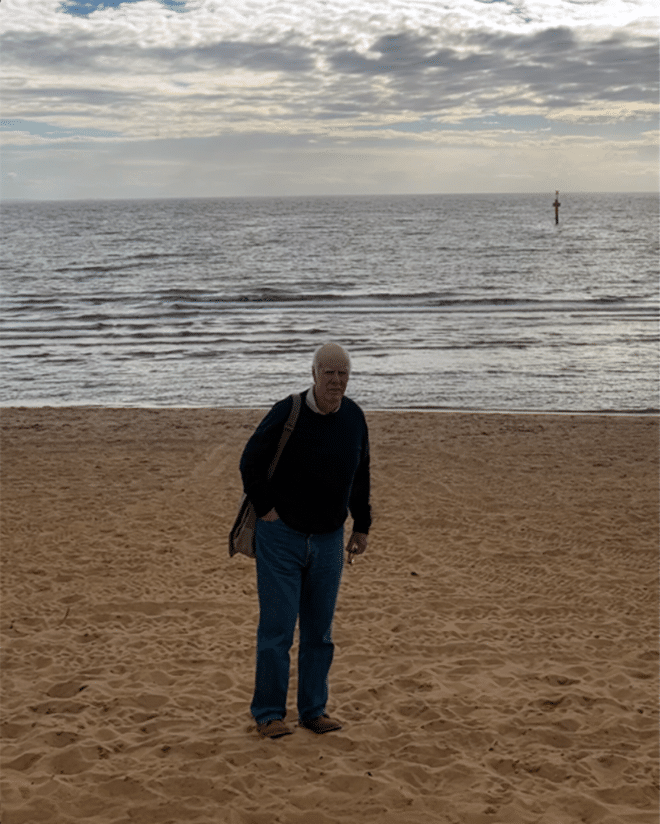
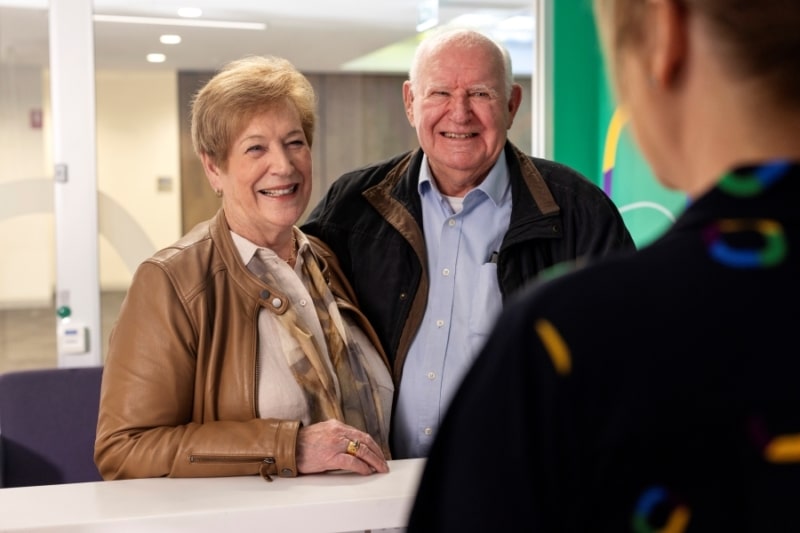
“I am writing this letter to thank Dr Bowden, Dr Conway and all of your team for the specialised radiation therapy that you have provided on the TRANSFORM trial and are continuing to provide in the treatment of my prostate cancer,” wrote Ian.
“There is absolutely no doubt in my mind that as a result of the treatment I have been fortunate to have received from you and your team, that my life has been extended far beyond what I could have expected.
“After I retired in 2009, I decided that it would be wise to have an annual medical checkup,” continues Ian. “I had absolutely no symptoms prior to my diagnosis and according to Dr Google, my prostate-specific antigen (PSA) reading at the time of diagnosis, which from memory was 4.0, was within the bounds of normal for a person of my age.
“I had a radical prostatectomy in February 2013. I was advised that there were clear margins around the prostate, however once my PSA levels started to rise seven months following surgery, it was the opinion of my urologist that the cancer had spread through my seminal vesicles.
“My PSA continued to rise, and I was sent for a seven-week course of radiation therapy in early 2015 directed to the area of the prostate in the hope of killing off any residual cancer cells.
“Just prior to the course of radiation therapy, my PSA reading had been 0.14 and following this treatment my PSA had risen to 0.25 in April 2015 and to 0.33 by June that year, so it was obvious that the radiation therapy had not been successful.
“It was around October of 2015 when my PSA had risen to 0.40 that I was told about the possibility of joining the TRANSFORM clinical trial, using a combination of PSMA/PET scans followed by sessions of stereotactic radiation therapy directed at spots found on the scans.
“I was sent for scans in November 2015, which found three spots identified on my rib, hip and spine. I was subsequently accepted onto the TRANSFORM trial in January 2016,” said Ian.